Sunday, August 9, 2009

Scatterplot

Scatterplots are used to graph data using the cartesian plane. The data is all selected with the point on the x axis determining where on the y axis the points will fall. All of the individual points graphed together help to give a view of how the data reacts overall.

http://images.google.com/imgres?imgurl=http://argyll.epsb.ca/jreed/math9/strand4/scatterplot1.gif&imgrefurl=http://argyll.epsb.ca/jreed/math9/strand4/4103.htm&usg=__Vkq_omWHAUwEnSSIjpV8UrLeh84=&h=342&w=386&sz=3&hl=en&start=3&um=1&tbnid=qGA02ra6hj-tPM:&tbnh=109&tbnw=123&prev=/images%3Fq%3Dscatterplot%26hl%3Den%26client%3Dsafari%26rls%3Den-us%26sa%3DN%26um%3D1

Range Graded Proportional Circle Graph


This is also a graph where the circles are directly proportional to the variable being portrayed from that distinct area. The difference in the range graded is that there is only one variable being represented unlike the continuously variable circle maps. It is helps in the ease of reading. This is a map of Mexican population in the West.

Population profile

The population profile is a way to chart data and characterize it in terms of a persons age. Usually it will represent all of the people in the population, and then it will highlight a smaller and more select group. This graph also can help to show how this group is affected over time and with different age groups.

http://images.google.com/imgres?imgurl=http://www.ifad.org/operations/regional/pf/figure1.gif&imgrefurl=http://www.ifad.org/operations/regional/pf/aids_1.htm&usg=__T9NIj9Ua-EqX2y0qr_tpYFzeptM=&h=365&w=533&sz=7&hl=en&start=2&um=1&tbnid=1A_xvum0F1zaWM:&tbnh=90&tbnw=132&prev=/images%3Fq%3Dpopulation%2Bprofile%26hl%3Den%26client%3Dsafari%26rls%3Den-us%26sa%3DN%26um%3D1

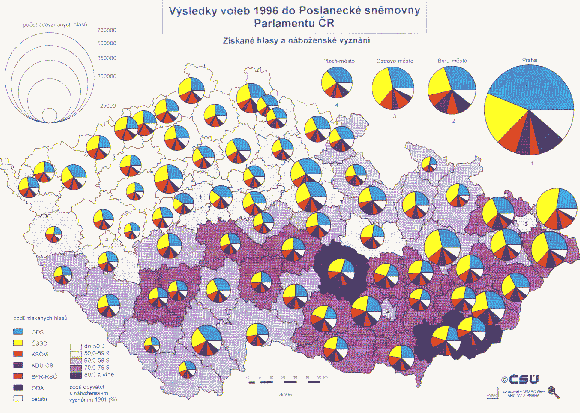
Continuously variable proportional circle map


These maps are proportional circle maps, with another variable inside the circle in the form of a pie chart. The circles not only represent a number directly proportional to the size and another percentage variable also. This continuously variable prop circle map is from Czech Republic.

http://geographyfieldwork.com/Choropleth2.gif


Climograph


Climographs help to chart the amount of precipitation and the temperature of a certain place over an extended period of time. The amount of precipitation is given by the bar graphs, while the temperature is charted by the line graph. This helps to try and draw conclusions about a correlation between the two. 
http://www.google.com/imgres?imgurl=http://wps.prenhall.com/wps/media/objects/214/219557/climograph2_national_drought%2520_mitigation_center.gif&imgrefurl=http://wps.prenhall.com/esm_tarbuck_escience_10/3/857/219574.cw/index.html&h=246&w=350&sz=19&tbnid=iH_EVhmV6By8oM:&tbnh=84&tbnw=120&prev=/images%3Fq%3Dclimograph&usg=__4iKQqk3qqN4SglceKQOtuCs3W3g=&ei=yl5_SpqiIOjBtweBhbXzAQ&sa=X&oi=image_result&resnum=6&ct=image

Standardized Choropleth Maps


A standardized map uses information that is uniform and can easily be displayed across a wide area. The data is areally averaged and usually shown with a color code as in this map. This map shows the amount of the Canadian population that is under 14.

http://www.statcan.gc.ca/pub/92f0138m/2008003/figures/figure3.1-en.jpg

Windrose


The wind rose is a tool that is used predominantly by meteorologists. It is used to determine the wind speed and direction of the surrounding areas as it could affect flight and weather conditions. The further out from the center that the colors extend, the more intense the data is.

http://images.google.com/imgres?imgurl=http://www.crh.noaa.gov/images/sgf/climate/windrose/windrose_sgf_jan.png&imgrefurl=http://www.crh.noaa.gov/sgf/%3Fn%3Daviation_forecasts&usg=__SelXVMMUjKNMWFe8gxiP8SNoEQ0=&h=473&w=402&sz=16&hl=en&start=10&um=1&tbnid=cJelK1CptHkwbM:&tbnh=129&tbnw=110&prev=/images%3Fq%3Dwindrose%26hl%3Den%26client%3Dsafari%26rls%3Den-us%26sa%3DN%26um%3D1