Sunday, August 9, 2009

Bilateral Graph

A bilateral graph is a histogram that can display different information such as location and amount, on one histogram. They are very useful in side-by-side comparisons. This is a bilateral graph of peoples approval of China's leadership and where the opinion is coming from.

http://media.gallup.com/poll/graphs/080429China2Graph2_GASJIDHUQfredo.gif

Bivariate Choropleth Map


A bivariate choropleth map is a choropleth map that displays more than one variable at a time, with different amounts of shading or with other different map layers. These maps can convey large amounts of information, such as this one about land use, per capita spending, and life expectancy in Africa.

Lorenz curve

The lorenz curve helps to visualize the cumulative distribution function, and it used mostly in economics. It is most commonly used to show the way income is distributed, and it usually represents the bottom % of households and the amount of money that they receive. 


http://www.google.com/imgres?imgurl=http://content.answers.com/main/content/img/oxford/Oxford_Geography/0198606737.lorenz-curve.1.jpg&imgrefurl=http://www.answers.com/topic/lorenz-curve&h=436&w=431&sz=27&tbnid=hwE39wO2MLKC8M:&tbnh=126&tbnw=125&prev=/images%3Fq%3Dlorenz%2Bcurve&usg=__Su0dmMx-rqkSoU1ikmc5-S75Dts=&ei=jmZ_SuiYNseOtgf35-zgAQ&sa=X&oi=image_result&resnum=4&ct=image

Univariate Choropleth Map


Univariate Choropleth maps are the standard choropleth map that displays only one variable with shading or different colors. This is a map of where the most hay is in the United States, with the darker green representing more.

Nominal Area Choropleth


Nominal area choropleth are maps with data that cannot be ordered any particular way or be shown any particular way except with colors. A great example would be this map, a map of the states and their electoral votes and who won the state. The data can be easily displayed in this format.

http://politicalmaps.org/wp-content/uploads/2007/12/2008-prediction-map-11252007.jpg

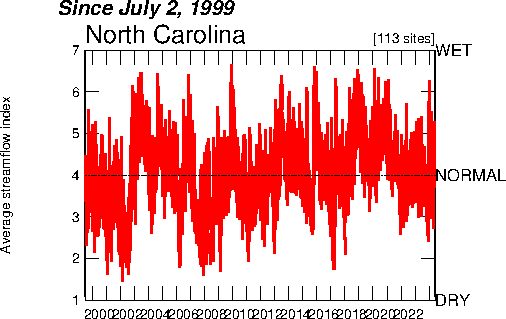
Index value plot


The index value plot can help to track data over a series of time. This plot shows the average streamflow in North Carolina, and keeps track of whether it was wetter and drier in relation to the historical data. 


http://images.google.com/imgres?imgurl=http://waterwatch.usgs.gov/regplots/real/real_nc_2.gif&imgrefurl=http://water.usgs.gov/waterwatch/%3Fm%3Dreal%26r%3Dnc%26w%3Dreal%252Cplot&usg=__vkTvnbBvoJv--Wb2BHENjNSJMNU=&h=450&w=550&sz=10&hl=en&start=17&um=1&tbnid=1sBUYWU8PsTYWM:&tbnh=109&tbnw=133&prev=/images%3Fq%3Dindex%2Bvalue%2Bplot%26hl%3Den%26client%3Dsafari%26rls%3Den-us%26sa%3DN%26um%3D1

Unclassed Choropleth Map


An unclassed choropleth map displayes categorical information without the same parameters as a classed choropleth map. This technique uses just shading to portray the information instead of shading and boundaries. This map displayes how republican and democratic the counties in the us voted.

Scatterplot

Scatterplots are used to graph data using the cartesian plane. The data is all selected with the point on the x axis determining where on the y axis the points will fall. All of the individual points graphed together help to give a view of how the data reacts overall.

http://images.google.com/imgres?imgurl=http://argyll.epsb.ca/jreed/math9/strand4/scatterplot1.gif&imgrefurl=http://argyll.epsb.ca/jreed/math9/strand4/4103.htm&usg=__Vkq_omWHAUwEnSSIjpV8UrLeh84=&h=342&w=386&sz=3&hl=en&start=3&um=1&tbnid=qGA02ra6hj-tPM:&tbnh=109&tbnw=123&prev=/images%3Fq%3Dscatterplot%26hl%3Den%26client%3Dsafari%26rls%3Den-us%26sa%3DN%26um%3D1

Range Graded Proportional Circle Graph


This is also a graph where the circles are directly proportional to the variable being portrayed from that distinct area. The difference in the range graded is that there is only one variable being represented unlike the continuously variable circle maps. It is helps in the ease of reading. This is a map of Mexican population in the West.

Population profile

The population profile is a way to chart data and characterize it in terms of a persons age. Usually it will represent all of the people in the population, and then it will highlight a smaller and more select group. This graph also can help to show how this group is affected over time and with different age groups.

http://images.google.com/imgres?imgurl=http://www.ifad.org/operations/regional/pf/figure1.gif&imgrefurl=http://www.ifad.org/operations/regional/pf/aids_1.htm&usg=__T9NIj9Ua-EqX2y0qr_tpYFzeptM=&h=365&w=533&sz=7&hl=en&start=2&um=1&tbnid=1A_xvum0F1zaWM:&tbnh=90&tbnw=132&prev=/images%3Fq%3Dpopulation%2Bprofile%26hl%3Den%26client%3Dsafari%26rls%3Den-us%26sa%3DN%26um%3D1

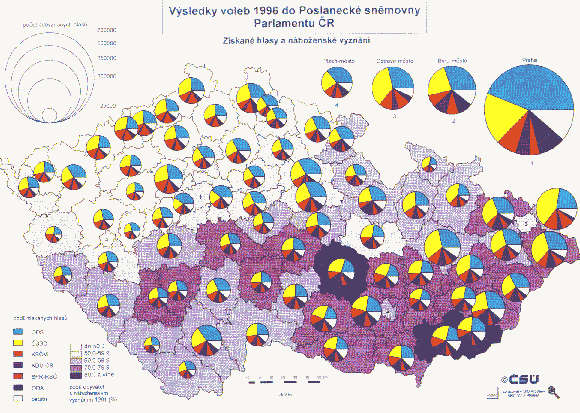
Continuously variable proportional circle map


These maps are proportional circle maps, with another variable inside the circle in the form of a pie chart. The circles not only represent a number directly proportional to the size and another percentage variable also. This continuously variable prop circle map is from Czech Republic.

http://geographyfieldwork.com/Choropleth2.gif


Climograph


Climographs help to chart the amount of precipitation and the temperature of a certain place over an extended period of time. The amount of precipitation is given by the bar graphs, while the temperature is charted by the line graph. This helps to try and draw conclusions about a correlation between the two. 
http://www.google.com/imgres?imgurl=http://wps.prenhall.com/wps/media/objects/214/219557/climograph2_national_drought%2520_mitigation_center.gif&imgrefurl=http://wps.prenhall.com/esm_tarbuck_escience_10/3/857/219574.cw/index.html&h=246&w=350&sz=19&tbnid=iH_EVhmV6By8oM:&tbnh=84&tbnw=120&prev=/images%3Fq%3Dclimograph&usg=__4iKQqk3qqN4SglceKQOtuCs3W3g=&ei=yl5_SpqiIOjBtweBhbXzAQ&sa=X&oi=image_result&resnum=6&ct=image

Standardized Choropleth Maps


A standardized map uses information that is uniform and can easily be displayed across a wide area. The data is areally averaged and usually shown with a color code as in this map. This map shows the amount of the Canadian population that is under 14.

http://www.statcan.gc.ca/pub/92f0138m/2008003/figures/figure3.1-en.jpg

Windrose


The wind rose is a tool that is used predominantly by meteorologists. It is used to determine the wind speed and direction of the surrounding areas as it could affect flight and weather conditions. The further out from the center that the colors extend, the more intense the data is.

http://images.google.com/imgres?imgurl=http://www.crh.noaa.gov/images/sgf/climate/windrose/windrose_sgf_jan.png&imgrefurl=http://www.crh.noaa.gov/sgf/%3Fn%3Daviation_forecasts&usg=__SelXVMMUjKNMWFe8gxiP8SNoEQ0=&h=473&w=402&sz=16&hl=en&start=10&um=1&tbnid=cJelK1CptHkwbM:&tbnh=129&tbnw=110&prev=/images%3Fq%3Dwindrose%26hl%3Den%26client%3Dsafari%26rls%3Den-us%26sa%3DN%26um%3D1

DOQQ


A DOQQ is an aerial photo that has been corrected for any distortions. That way it is possible to measure true distances and area from the photo. This a DOQQ of a region in North Carolina.

http://www.bae.uky.edu/uk-arc/images/Woodford/doqq.jpg

Triangle plot

The triangle plot is a way so judge how three variables react in relation to each other. The three variables are represented by each side of the triangle and the plots on the inside show how much each variable is represented in the data. This is most commonly used in geology, with the example showing soil composition in different areas, represented by the smaller red triangles.

http://www.dplot.com/triangle_plot.htm

DEM


A DEM is a digital elevation model and is a digital representation of ground surface topography or terrain. It provides an almost 3-d view of the landscape. This is a DEM of the continent of Antarctica.

http://nsidc.org/data/docs/daac/nsidc0304_0305_glas_dems/GLAS_Antarctic_DEM.jpg

DLG


A DLG is a digital line graph that is used by the USGS. It is spatial data in a digital vector image. This is a DLG of Lake Tahoe and the surrounding land. Notice how it is accurate information, but is not a real life portrayal of the landscape.

Parallel coordinate graph

The parallel coordinate graph is a way to plot a number of different data responses on the same graph. The graph consists of multiple over-lapping line plots that show how similarly the data reacts. This can be most effectively used to see how certain small groups react in relation to how the larger group of data acts as a whole.

http://www.evl.uic.edu/aej/526/kyoung/Training-parallelcoordinate.html

Isopleth

Isopleths uses different colors in different spatial areas to represent a numercal scale and its coordinating value. This map represents the different Hydrogen Ion concentrations from across the US.


http://nadp.sws.uiuc.edu/isopleths/maps2003/phfield.gif